
Client: Sustentarea – University of São Paulo (USP)
Sector: Education, Sustainability & Tabletop Games
Timeline: 1 year (Jun 2025 – Jun 2026)
My Role: Creative Direction, Art Direction, Brand Identity Design
Keywords: Creative Direction, Brand Strategy, Visual Storytelling, Editorial Design, Creative Project Management, Print Production.

"do Campo ao Prato" (From Farm to Table) is an educational initiative by USP's Sustentarea, exploring food chains and sustainability. Through Brand Strategy and Visual Storytelling, my goal was to take academic research insights and translate them into a tactile, and accessible tabletop experience for children.


THE CHALLENGE: We needed a visual identity and symbol system that respected the academic understanding of the food chain and consumption, yet felt playful and intuitive for kids. From a Creative Project Management standpoint, I also had to navigate budget constraints, optimize file architecture to ensure seamless future updates and establish a flawless hand-off for our printing partners.

CREATIVE STRATEGY & CONCEPT: To communicate sustainability, I intentionally moved away from a corporate look. The brand identity design embraces a pastel palette, watercolor-inspired styling, and organic elements such as leaves, and unbleached paper textures. This visual strategy set a welcoming tone that resonates with younger audiences

TYPOGRAPHIC & VISUAL SYSTEM (The Craft) A card game requires a strong Editorial Design system. I built a dynamic structural grid that allows for scalable changes across imagery, text, and iconography. The game cards are divided into 2 types and 5 categories. In addition, each card has na impact on ‘energy’ and ‘cost’. The 2 types are divided by background card color, and the five categories are marked with 5 distinct colors and icons.

For the typography, we took a dual approach: cards and rulebook. The cards use a serif typeface Roboto Serif to bring reading comfort and ground the watercolor illustrations. On each card, there is an information hierarchy where the action text stands out more than the educational text. For the rulebook and packaging—where space was much tighter—I went with sans-serif Futura to maximize readability.

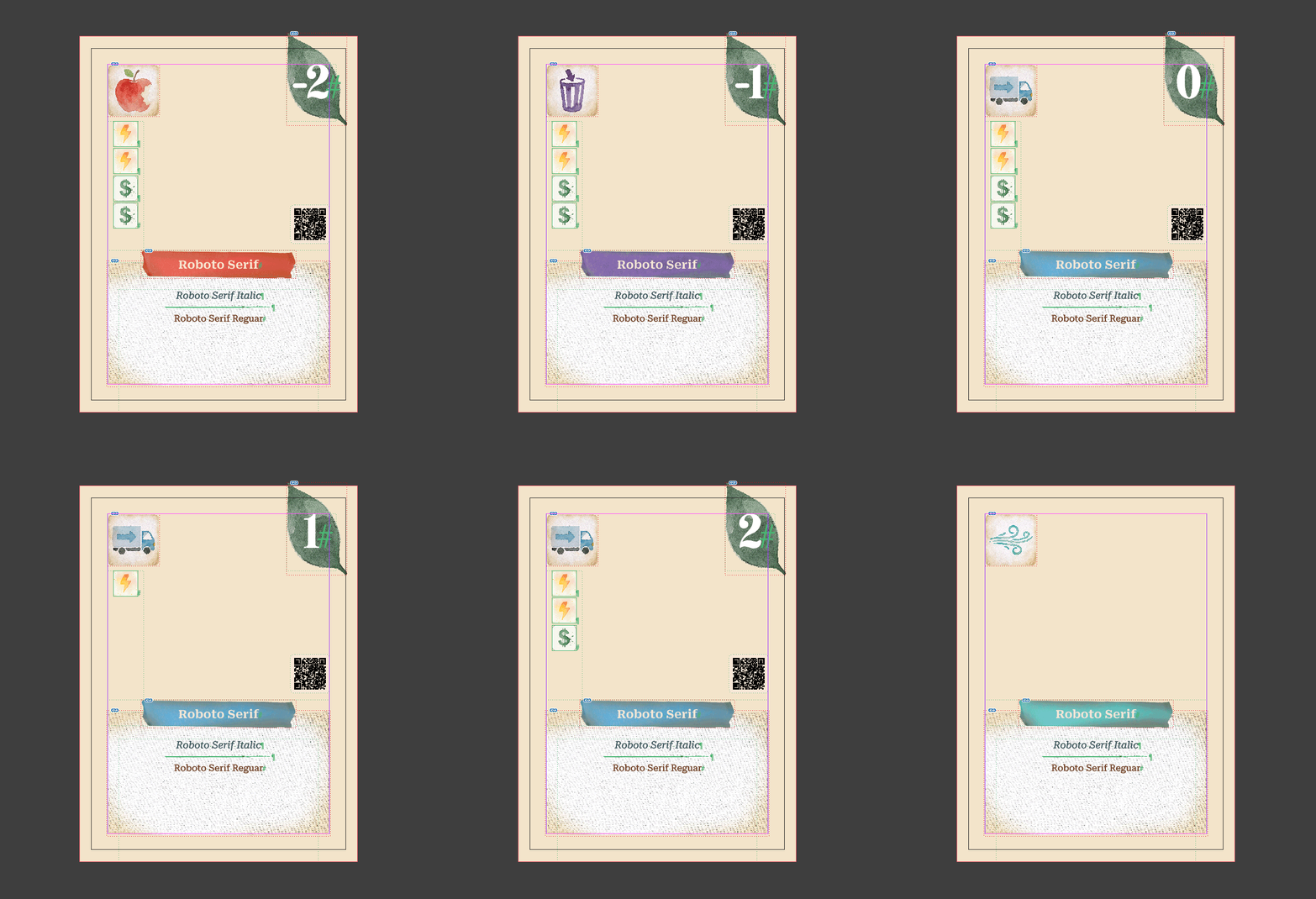

ART DIRECTION & PRINT PRODUCTION: As the Art Director, I guided the curation and refinement of the core card illustrations, which were primarily AI-generated by the client. My focus was on establishing a visual language, adjusting every single asset for color accuracy, scale, and proportion to fit our grid.
This standardization allowed us to automate some process, speeding up production. When it came to Print Production, I didn't just delivered print-ready files; I actively consulted with the client and print shops, directing material choices and finishes that would bring the project to life within their specific budget.


RESULTS & IMPACT The final product was enthusiastically adopted by USP and even highlighted at the Brazilian Congress of Nutrition. The game was tested as an active teaching methodology in early childhood education and successfully met its initial objectives. The real-world success of the game helped secure additional backing from CNPq and the Federal Government's Ministry of Health, paving the way for a second, expanded print run.

"Working with Lucas was an game-changer for 'do Campo ao Prato'. I came to him with the mechanics and the educational core, but he was the one who brought it to life visually.
As a result, when I used the game with children aged 8 to 12, they were delighted by the beauty of the materials. Moreover, I was able to count on his expertise to guide me on how to prepare the materials for printing at the printing company. He made the whole process much light and efficient"
Jadiane Sokulski
Creator of "do Campo ao Prato" & Researcher at Sustentarea (USP)

Game Concept & Development: Jadiane Soares Sokulski
Gameplay & Mechanics Development: Tiago Sokulski Teixeira
Creative and Art Direction: Lucas Sokulski Teixeira
Card Content & Copywriting: Leticia Gabriely Sampaio
Institutional Coordination (Sustentarea/USP): Aline Martins de Carvalho e Cláudia Maria Bógus